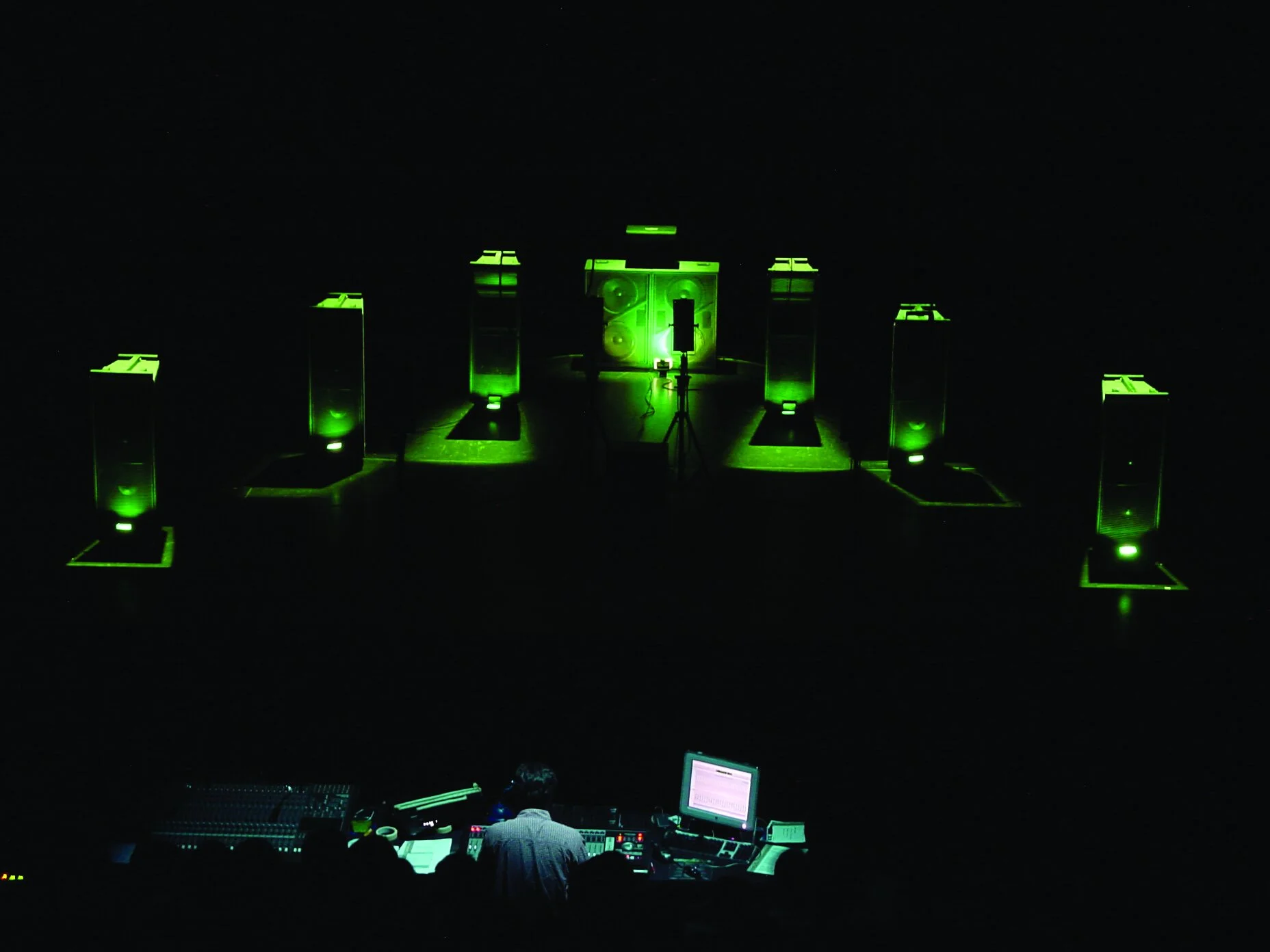
Peça de Ângela Lopes seleccionada para o WNMD 2021.
Piece by Ângela Lopes selected for the WNMD 2021.

Peça de Ângela Lopes seleccionada para o WNMD 2021.
Piece by Ângela Lopes selected for the WNMD 2021.
Expressive interactivity
The conventional way of producing sound with musical instruments implies some degree of interaction between the human agent and the instrument, mostly present in the struggle to control the forces and reactions, one that is informed by an embodied knowledge of the instruments' particular resonances and idiosyncrasies. The duality of gesture-as-movement and gesture-as-intention is therefore clearly presented in the process that transforms a physical performance gesture into the conveyed musical or sonic gesture.
Digital instruments and systems are often used to further expand the reach of these gestures, taking them beyond the physical capabilities of the performer. Traditional approaches favoured pre-conceived prosthetic gestures that were triggered during live performance, whereas the current paradigm is mostly based on the digital expansion of the regular capabilities of acoustic instruments. Whilst this often implies a decoupling of the aforementioned duality — favouring the musical or sonic gesture over the physical performance —, performers can still embody this expansion in order to exert and display a given degree of control over the musical outcome.
But what happens when the interactive capabilities of a digital system increase and the performer can no longer reasonably expect to fully control the outcome of his or her actions? Is the expressivity of the system compromised or are we facing a new kind of expressive potential? Who are the agents behind that expression? How can interactive musical systems expand our current notions of musical expressivity and musical agency? What does that bring for the composer, the sound designer, the performer or the audience? These are some of the questions that will be addressed in this talk, based on the implications that different concepts of interactivity have in our understanding of interactive music.
RUI PENHA
Composer, media artist, and performer of electroacoustic music, Rui Penha was born in Porto in 1981. He completed his PhD in Music (Composition) at the University of Aveiro. His music is regularly recorded and played in festivals and concert halls around Europe and North America, by musicians such as Arditti Quartet, Peter Evans, Remix Ensemble, or the Gulbenkian Orchestra. He was a founder and curator of Digitópia (Casa da Música, Porto) and has a deep interest on the relationship between music and its technology. His recent production includes interfaces for musical expression, sound spatialisation software, interactive installations, musical robots, autonomous improvisers, and educational software. More recently, Rui has focused his attention on the problems of defining and guiding artistic research. He taught at several Portuguese institutions, in both music, art and engineering faculties, and is currently an assistant professor at ESMAE and researcher at CESEM. More info at http://ruipenha.pt
Foi reactivado o Espaço Crítica para a Nova Música, um fórum on-line para crítica livre e aberta, em que podem ser confrontadas de uma forma lata e profunda, opiniões firmes e gostos diferentes sobre as novas tendências na música criada em Portugal. É um lugar dedicado, por um lado, a estéticas e expressões múltiplas, fenómenos da criação, narrativas musicais, performances/ concertos/ espectáculos da música de arte actual, por outro, à sua relação com outras áreas, tais como artes visuais, dança, arquitectura, literatura, novas tecnologias, psicologia e sociologia. Fazendo referência às palavras do poeta, jornalista e escritor francês Anatole France, no Espaço Crítica para a Nova Música os críticos «contam as aventuras das suas próprias almas entre as obras-primas».
A partir de Dezembro o Espaço Crítica para a Nova Música conta com a colaboração regular de Pedro Boléo, crítico, jornalista, musicólogo e músico, cujos dois textos sobre dois concertos que decorreram no mês passado no O'culto da Ajuda e no CCB em Lisboa já estão disponíveis on-line. O primeiro, >> Diversas vozes despertas, diz respeito ao concerto pelo Lisbon Ensemble XX/ XXI que teve lugar no contexto da Extensão Emergência do Festival Música Viva 2020 e que no programa incluiu obras de cinco compositores portugueses. O segundo texto, >> Uma viagem donde não se sai ileso, é uma crítica ao concerto intitulado Utopia, no âmbito do qual os Solistas do Sond'Ar-te Electric Ensemble e a Camerata Alma Mater, sob a direcção de Pedro Neves, estrearam o novo Triplo Concerto da autoria de Miguel Azguime.
compilação discográfica em livro de 6 novos Álbuns em formato digital .wav e mp3 com obras e poemas de Miguel Azguime
+ 5€ CCT Portugal
+ 10€ international shipping cost
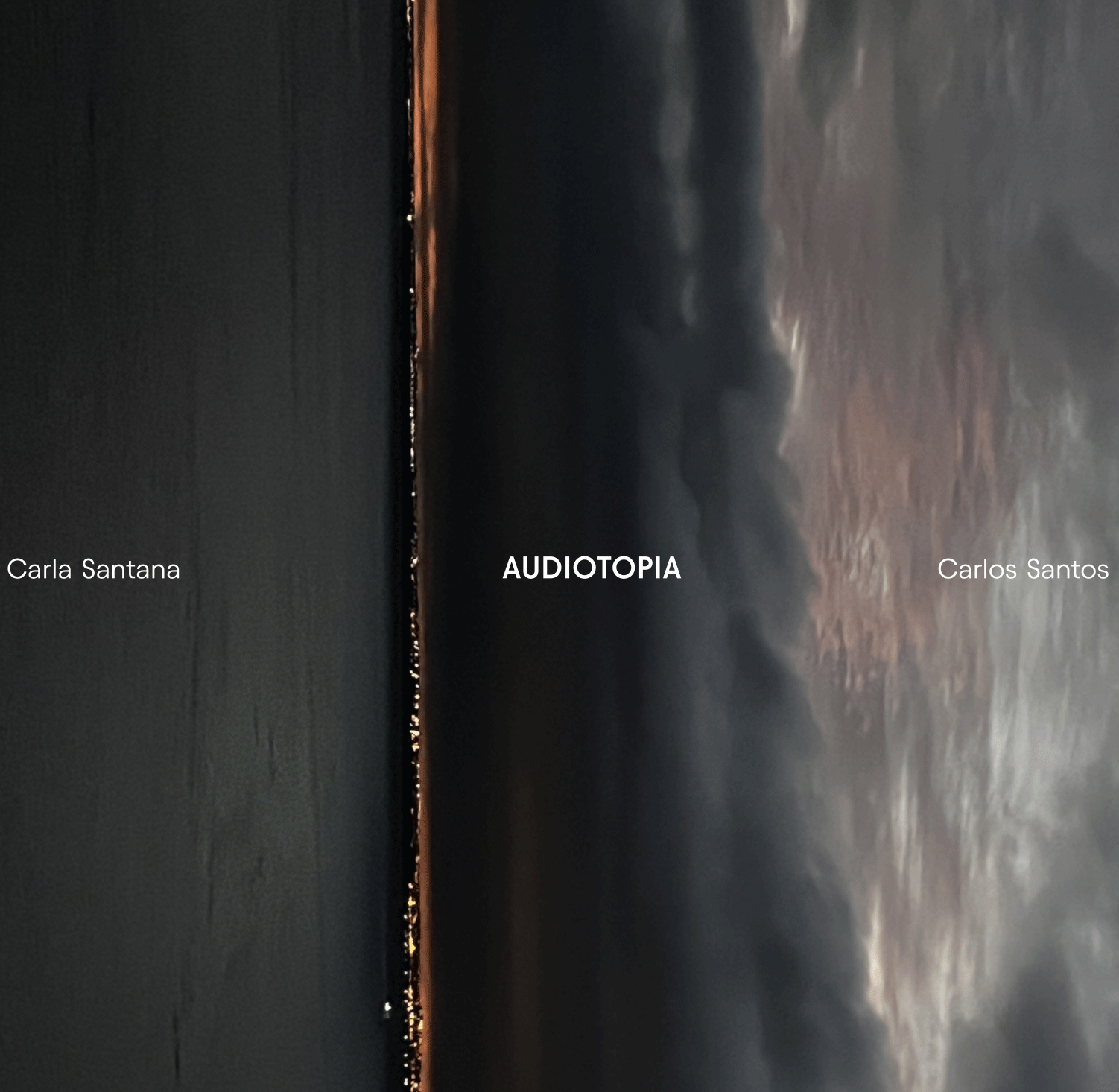
ADIOTOPIA
Carla Santana -sintetizador analógico, piezos, hidrofone e objectos
Carlos Santos - sintetizador modular, sampler, piezos e objectos
O som que se dissolve no espaço não é um ponto fixo, mas sim movimento entre o gesto e a ressonância do lugar. Existe no limiar entre o que poderia ser e uma trajetória. Um mapa de escuta, que habita o tempo.
Gravado ao vivo no O’Culto da Ajuda durante o Festival Curto-Circuito, 7 de Dezembro de 2024.
Mistura e masterização de Carlos Santos
Fotografias de Carla Santana
Design gráfico de Carlos Santos
ADIOTOPIA
Carla Santana – Analog synthesizer, piezos, hydrophone, and objects
Carlos Santos – Modular synthesizer, sampler, piezos, and objects
Sound dissolving into space is not a fixed point but rather a movement between gesture and the resonance of place. It exists on the threshold between what could be and a trajectory— a listening map that inhabits time.
Recorded live at O’Culto da Ajuda during the Curto-Circuito Festival on December 7, 2024.
Mixing and mastering by Carlos Santos
Photographs by Carla Santana
Graphic design by Carlos Santos
EIGHT DIALOGUES is the result of home sessions recordings made between 2016 March, and 2017 January, that caught Buchla brand’s attention, and they kept a video of our duo on the their homepage for a certain time. Sadly, these were the Music Easel creator, Don Buchla (1937-2016), last days.
This album’s music has its inspiration on how the characteristics, sound, and timbre of the Buchla Music Easel, and the Double Bass can influence each other, and construct together musical ideas, textures, melodic games, and forms, exploring at same time the spontaneous flow of improvisation, as a composition way.
As we both share fascination for the 20th century Avant-garde and Conceptual Art movements, and Don Buchla was pioneer of new synthesis concepts that became the West Coast style, connected to a more experimental point of view of the electronic music, we dedicate Eight Dialogs to Don Buchla, the creator of the Music Easel.
ARMANDO TEIXEIRA’s creative common denominator is electronics, whether in an experimental vision, or transposing discoveries, possibilities, and interpretations into genres from song to soundtrack. His electronics, but in an experimental approach, play a decisive role in his career, which has seen more than two dozen records released since 1994.
MIGUEL LEIRIA PEREIRA as double bassist has his strongest influence by Gary Karr, with who he have been in touch since 1996. He teaches the double bass at the Lisbon National Conservatory, as he keeps a musical activity in different areas, but with focus on music that brings the double bass into a creative path.
Both musicians have been working together since de mid 80's until present, and Eight Dialogues marks the point on this time line, that brings together the most personal, and at the same time, abstract representation of a long friendship and share, by a musical conversation.
ARMANDO TEIXEIRA: Buchla Music Easel
MIGUEL LEIRIA PEREIRA: Double Bass
Recorded 2016/2017, mixed and mastered in 2023, by Armando Teixeira, and Miguel Leiria Pereira.
DIALOGUE I
DIALOGUE II
DIALOGUE III
DIALOGUE IV
DIALOGUE V
DIALOGUE VI
DIALOGUE VII
DIALOGUE VIII
Support: Portuguese Republic, DGArtes, CML, EASTN, Creative Europe, CIME, MIC, Miso Studio, Miso Records.
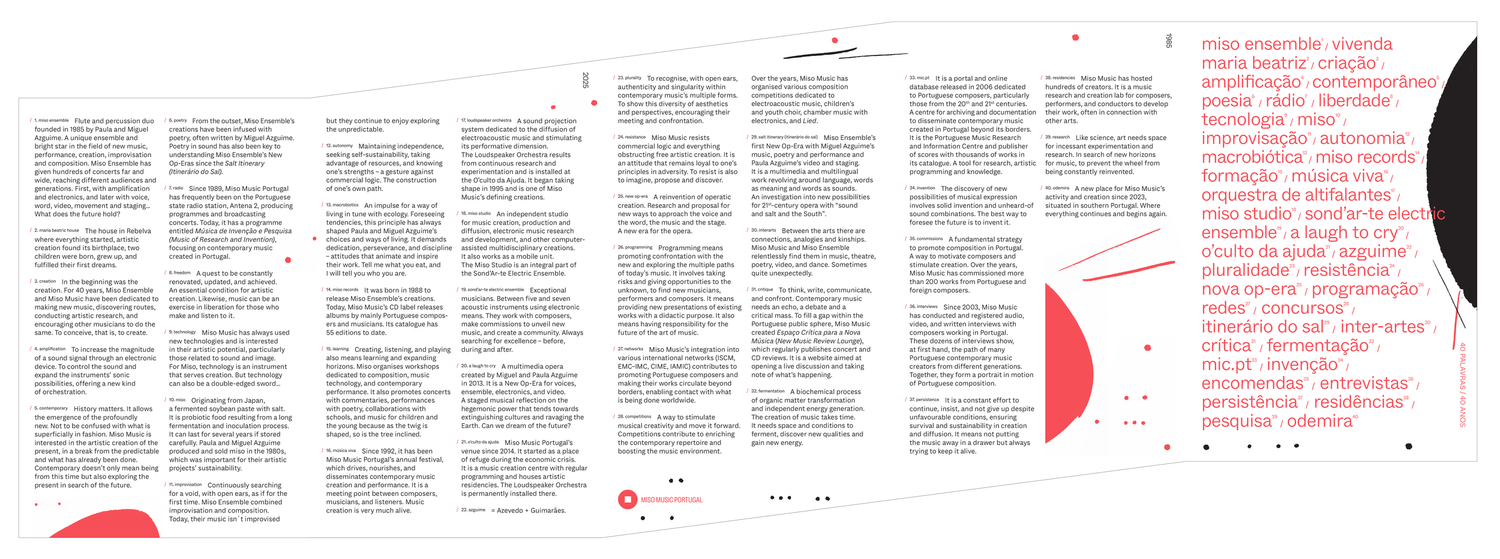
livro sobre os 40 anos de actividade da Miso Music Portugal
+ 9€ CTT Portugal
+ 15€ international shipping cost